CaptureAgent uses strictly necessary cookies only — encrypted session cookies that keep you signed in. No advertising or cross-site tracking. See our Privacy Policy.

Features

A complete capture shop, in one console

Everything between "there's a solicitation somewhere out there" and "package submitted" — then the raise that funds the next one, with a human approving every step.

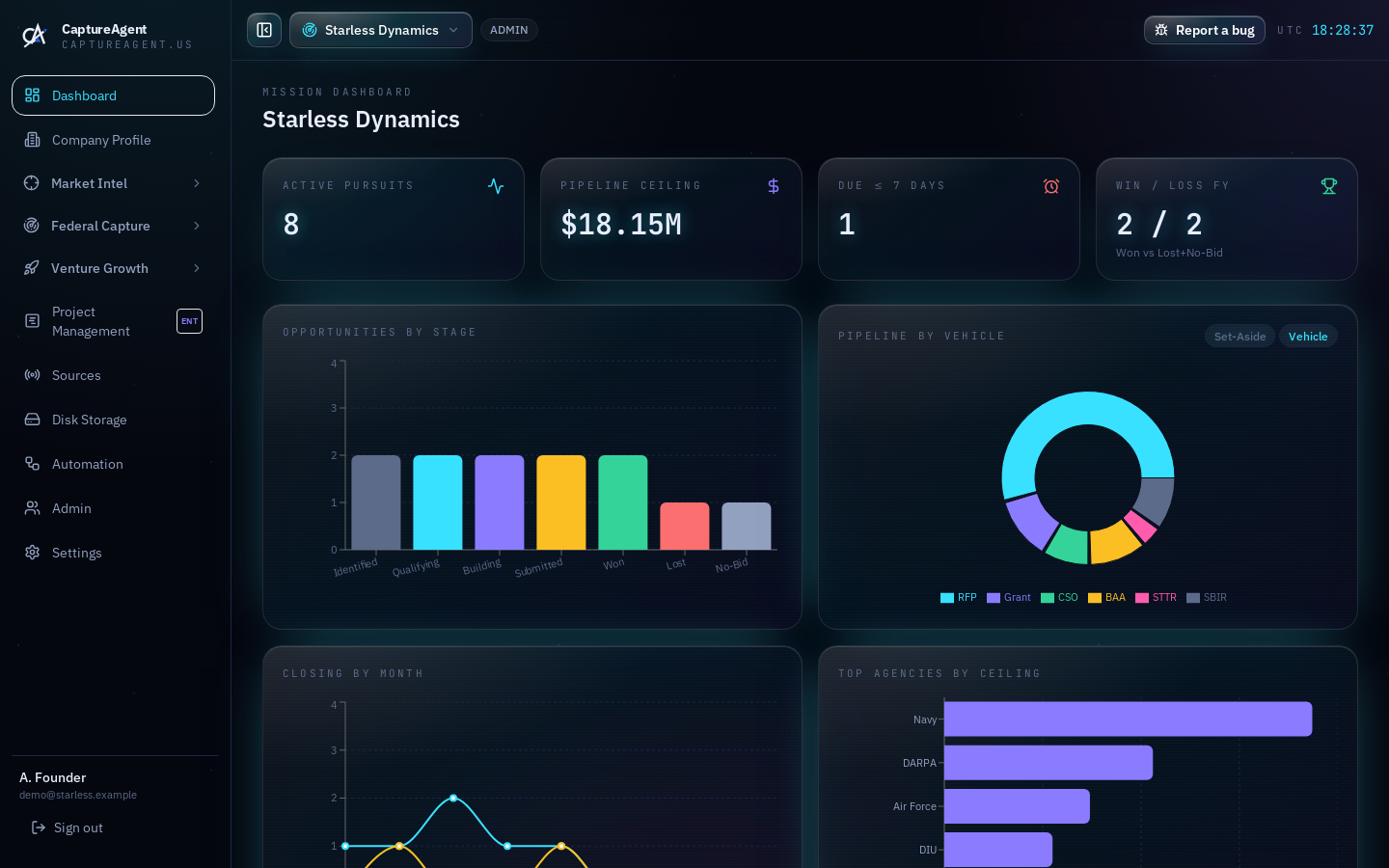
The capture console — pipeline by vehicle type, win/loss/no-bid, and portfolio health
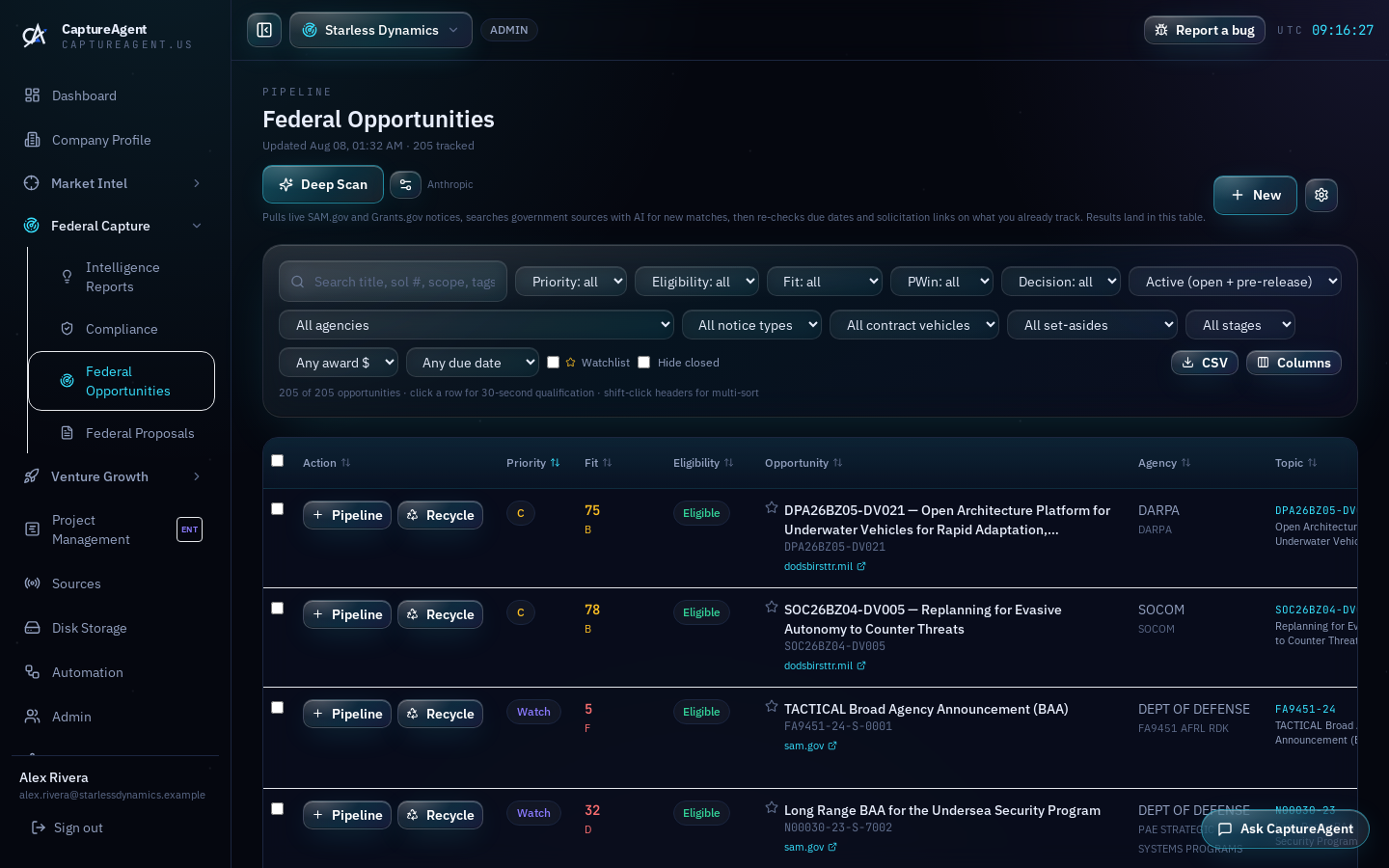
Federal opportunity table with fit scores, eligibility flags and due dates

Federal pipeline and Deep Scan

  • One-click pull from SAM.gov and Grants.gov matched to your NAICS, PSC codes and keywords — expired notices never surface, real award amounts do
  • Deep Scan runs Claude with live web search across SBIR/DSIP, AFWERX, SpaceWERX, DIU, DARPA, NASA, xTech, SOFWERX and MDA, fit-scoring every find 1–100 against your profile
  • Verify & Refresh re-checks each record against its live source and flags changed due dates or cancelled notices before you spend a week on one
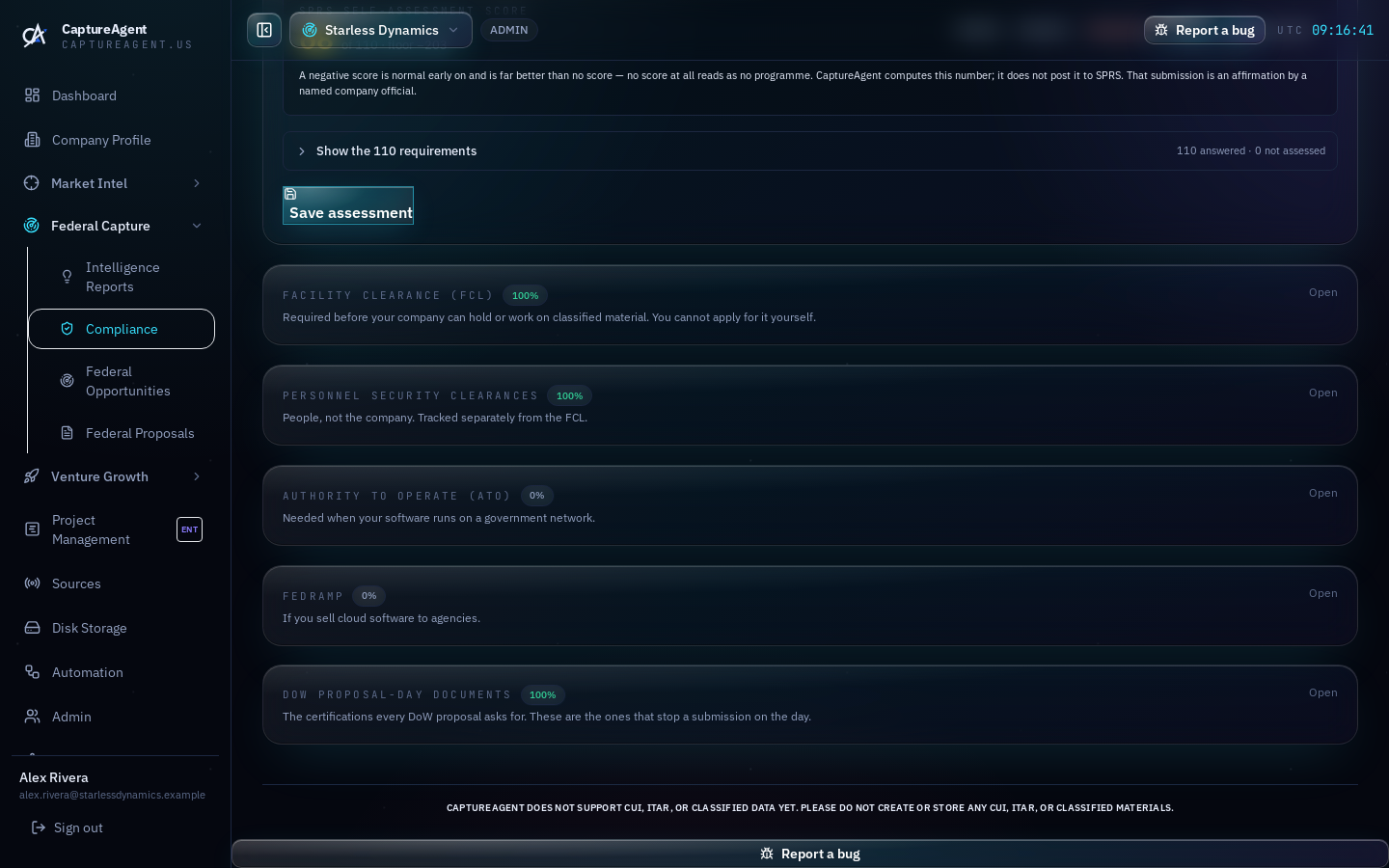
Compliance readiness with a computed SPRS self-assessment score

Compliance posture and CMMC scoring

  • Guided capture for the seven artifacts that gate defense work — ITAR/EAR and DD 2345 block by block, CMMC, FCL, clearances, ATO and FedRAMP
  • All 110 NIST SP 800-171 Rev 2 requirements as a working checklist with the evidence an assessor asks for, and your SPRS score computed from the DoD methodology with the arithmetic shown
  • Posture drives the eligibility gate on every opportunity: a topic needing export-controlled data names the exact missing artifact instead of warning you generically
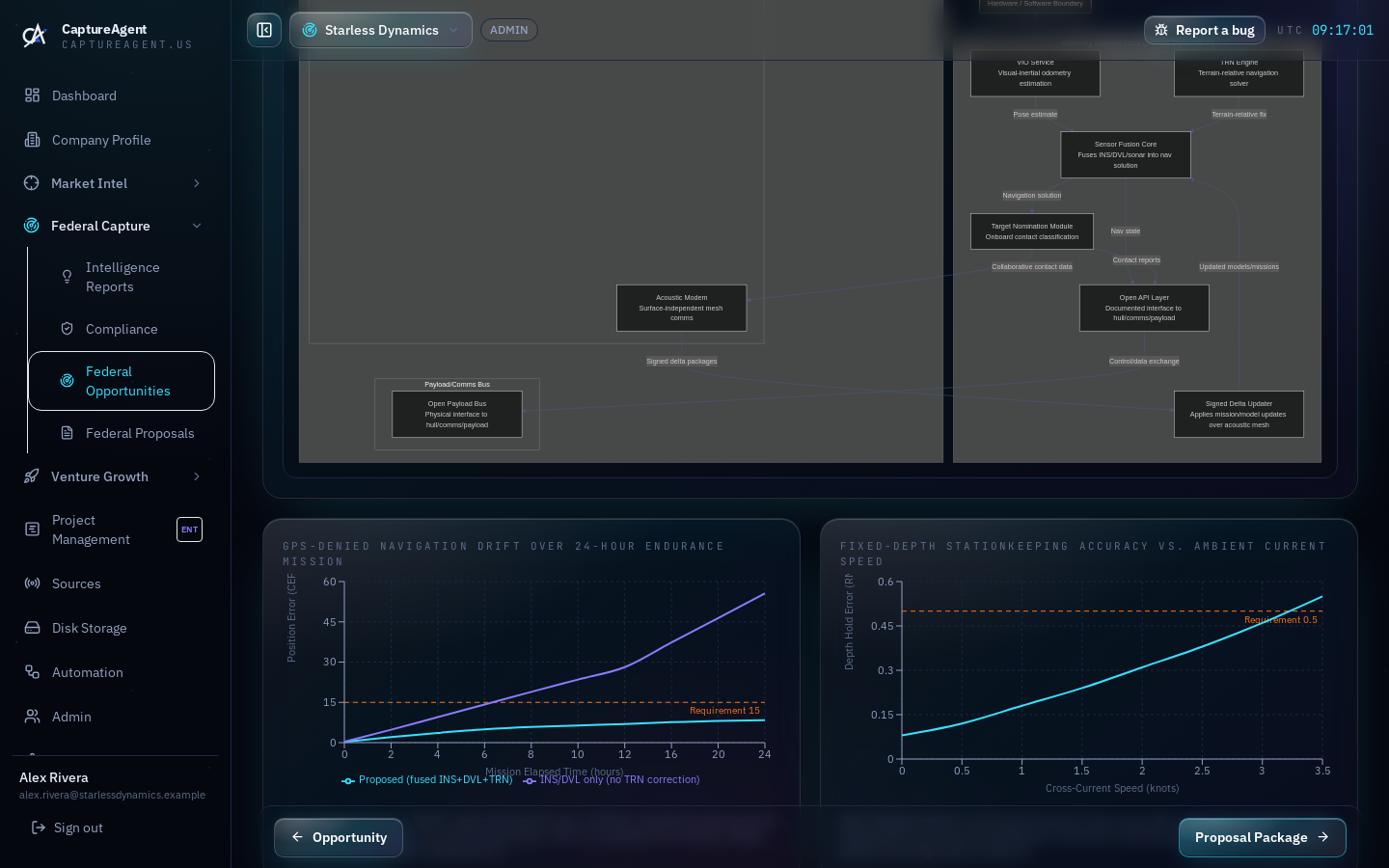
Generated capability with concept rendering, systems architecture and performance charts

AI capability designer

  • Title, abstract, executive summary and keywords grounded in the solicitation and your profile — never in the model's priors
  • A concept rendering, a systems architecture diagram and performance charts, plus requirement-traceability tables
  • Statement of Work, WBS with a month-by-month schedule, and a budget with basis-of-estimate narrative capped to the ceiling
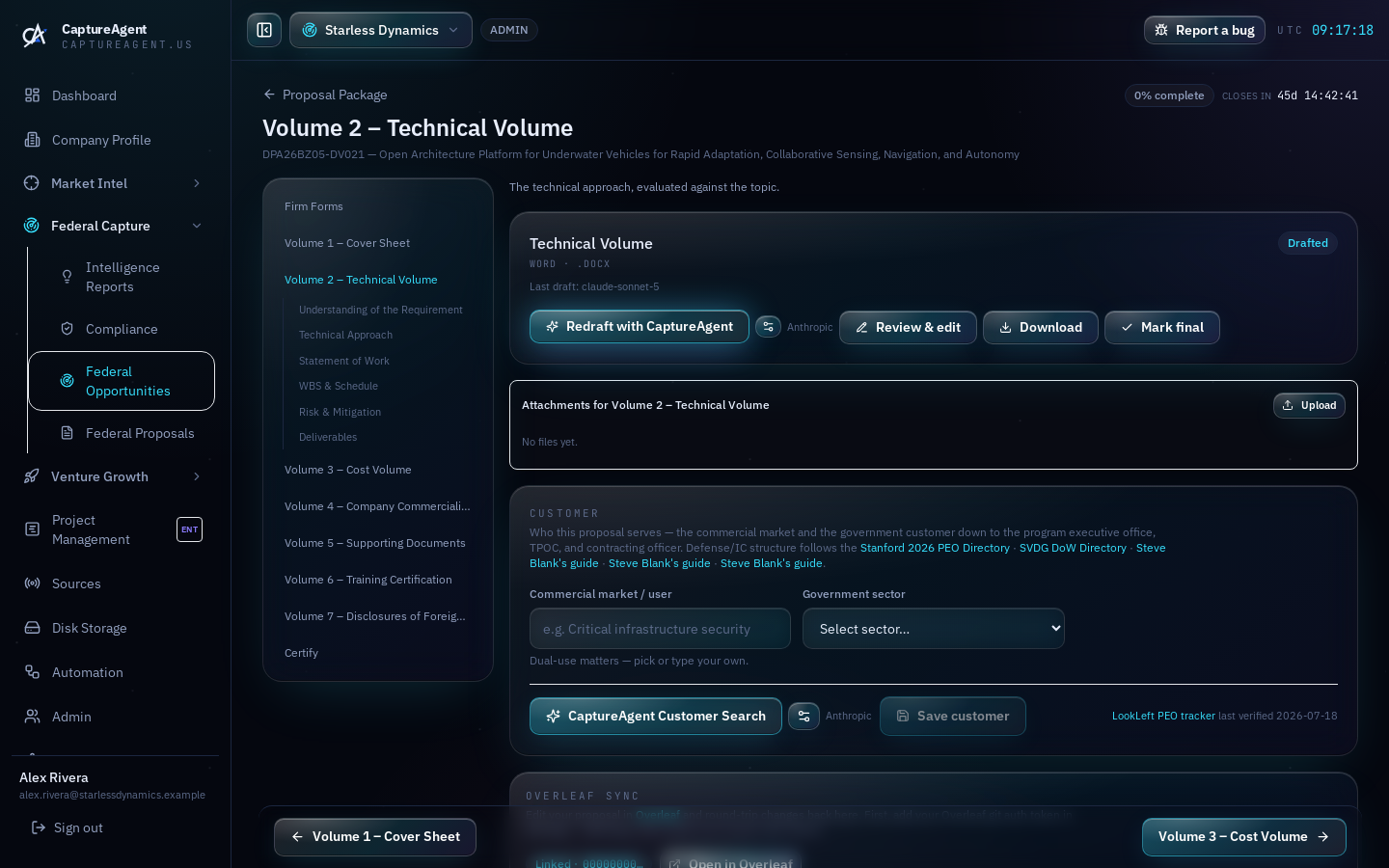
Technical volume drafted inside the proposal package

Volumes written to the solicitation

  • Where the solicitation prescribes a structure, the volume follows it — Section L headings in Section L order, or the Section M factors in the evaluator's order
  • The recorded evaluation factors and compliance matrix are handed to the drafter, so the narrative answers what will actually be scored
  • No house template stamped over the top: a theme statement appears where a section makes a claim worth proving, not at the head of every section
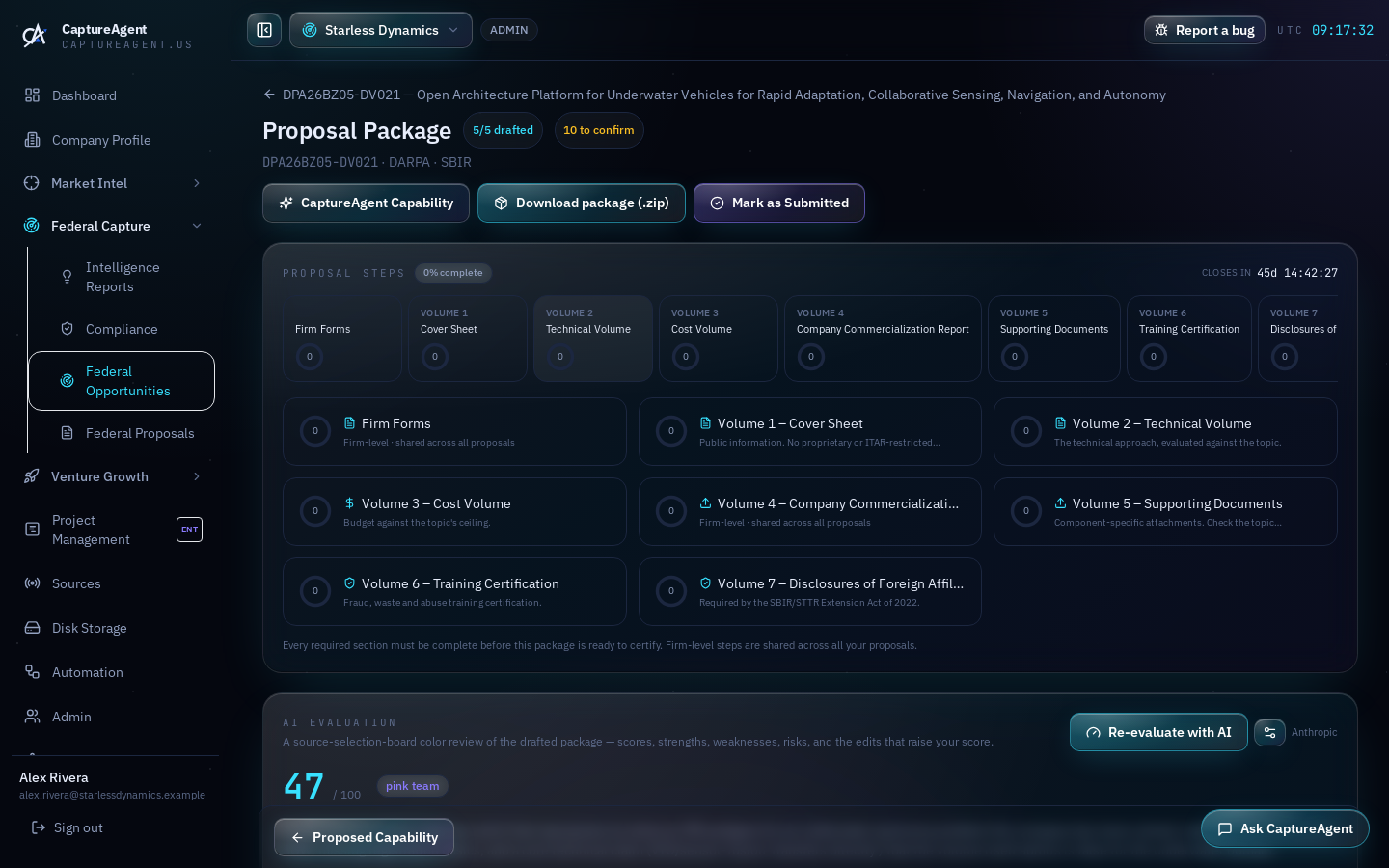
Proposal package with numbered volumes and drafting progress

Proposal package builder

  • Volume set adapts to the vehicle: RFP, SBIR/STTR, BAA, CSO or grant
  • Draft any volume with Claude or ChatGPT — your choice of engine, your keys — and edit in place: markdown for narratives, structured rows for cost
  • Export real .docx, .xlsx and .pptx files individually or the whole package as a zip
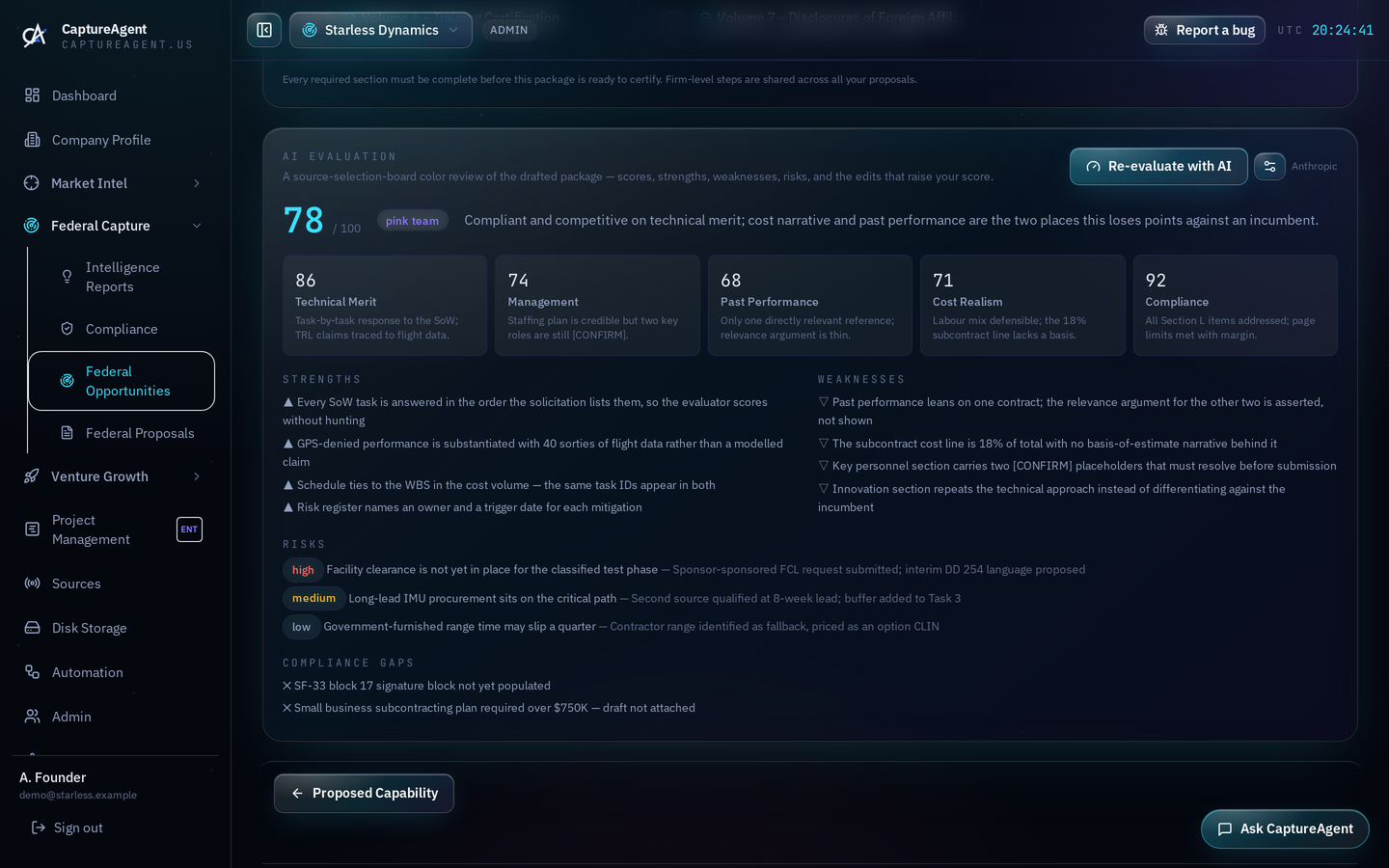
Color-team evaluation scoring the drafted package by factor

AI color-team evaluation

  • An SSEB-style review scores the drafted package 0–100 across five factors before the government sees it
  • Strengths, weaknesses, severity-rated risks with mitigations, and the compliance gaps that would draw a deficiency
  • A prioritized list of the edits that most raise your score — re-evaluate after each pass and watch it move
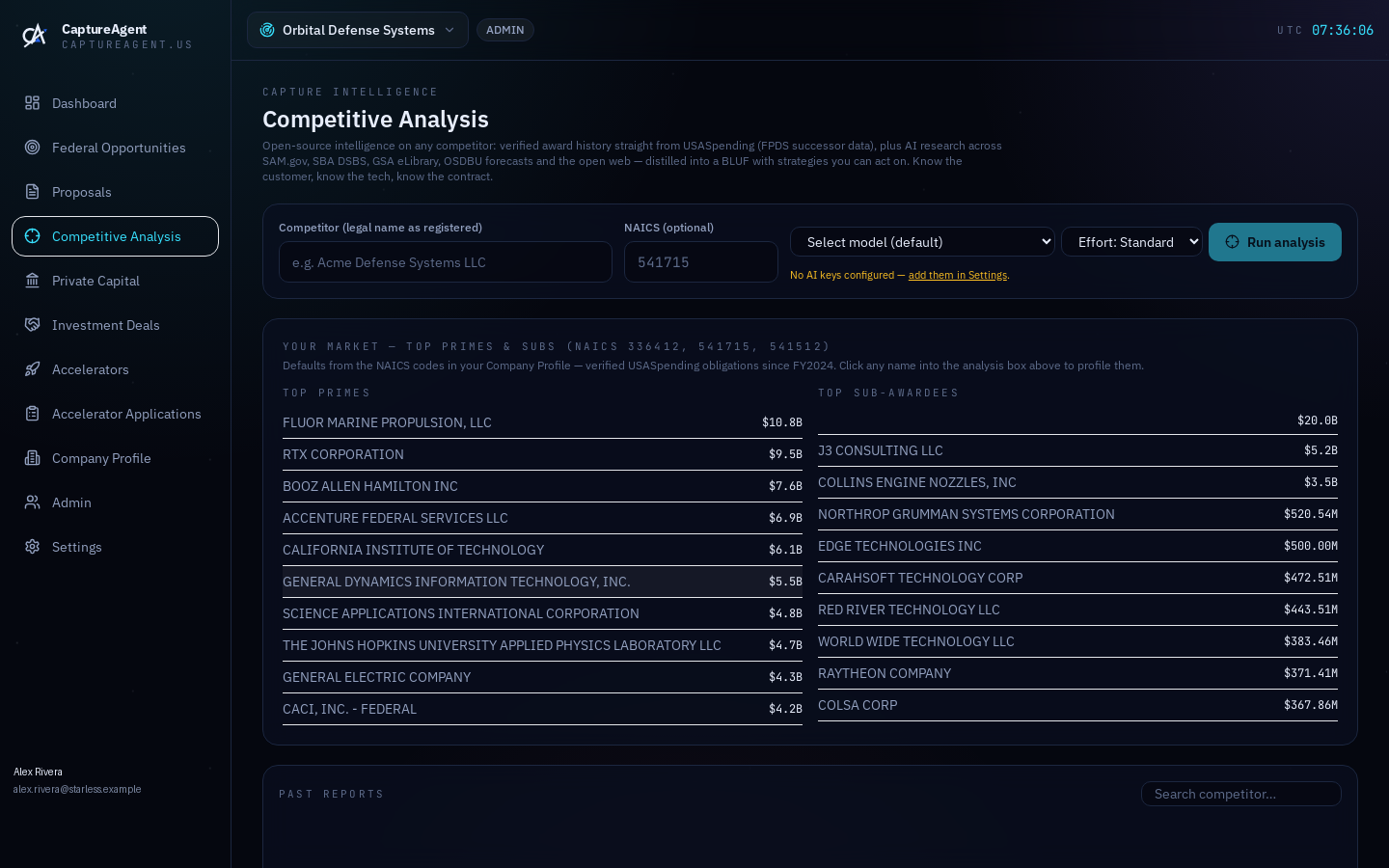
Competitor profile with verified federal award history

Competitive analysis (OSINT)

  • Verified federal award history for any competitor straight from USASpending — totals by year, top agencies, largest contracts with links
  • AI research across SAM.gov, SBA DSBS, GSA eLibrary and OSDBU forecasts, sources cited and nothing fabricated
  • BLUF up top — who they are, where they win, where they are beatable — then prime/sub/team plays and a recompete watch built from contract end dates
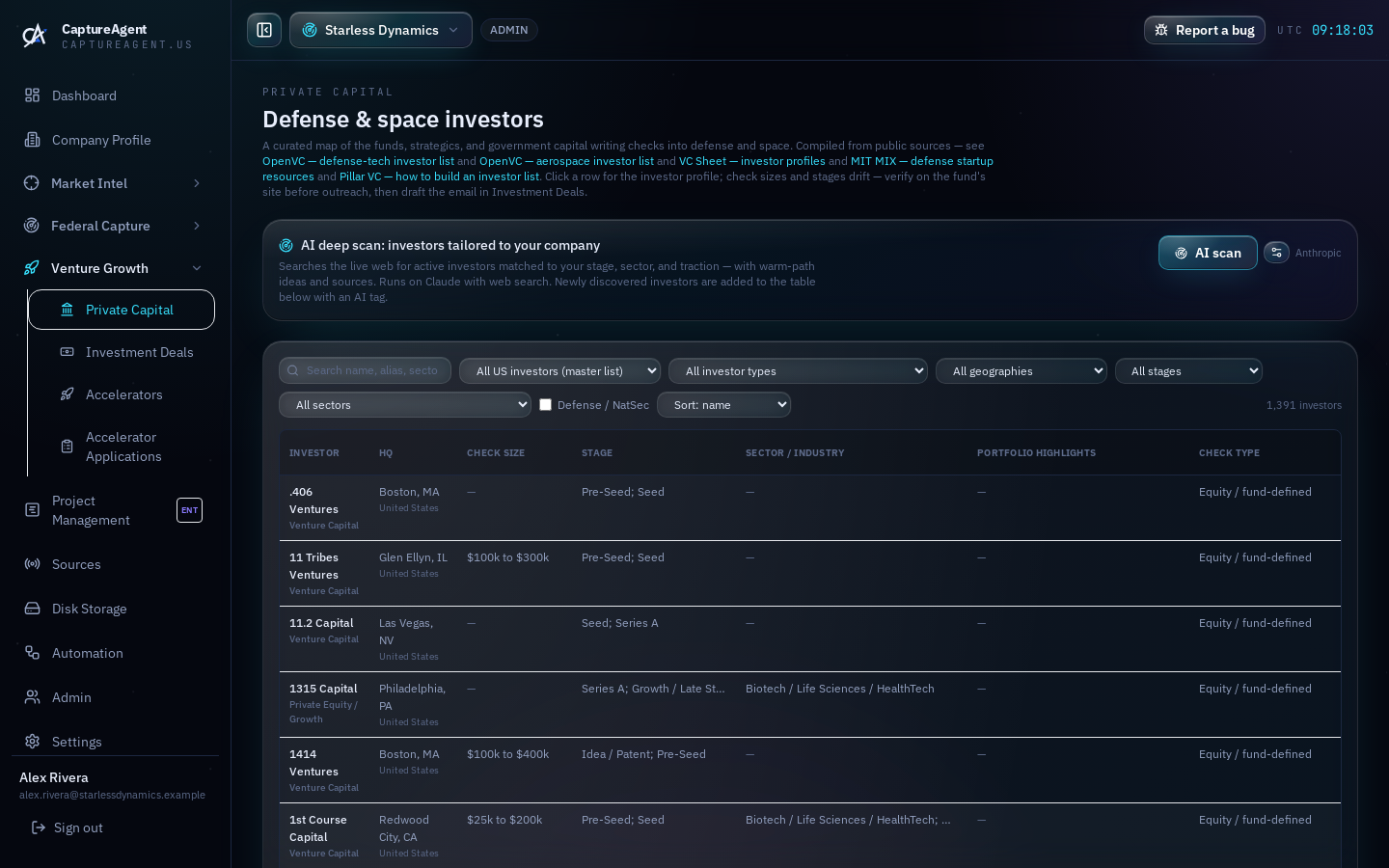
Investor master list with check size, stage, sector and contact route

Private capital master list

  • 1,391 US investors in one filterable table — HQ, check size, stage, sector, portfolio, lead-or-follow, and how each has published that it wants to be approached
  • Every row carries its own last-verified date and confidence, so you know what to trust before you send anything
  • Outreach drafted to the real route: the named partner where one is published, otherwise the recommended role through their own channel — never an invented name
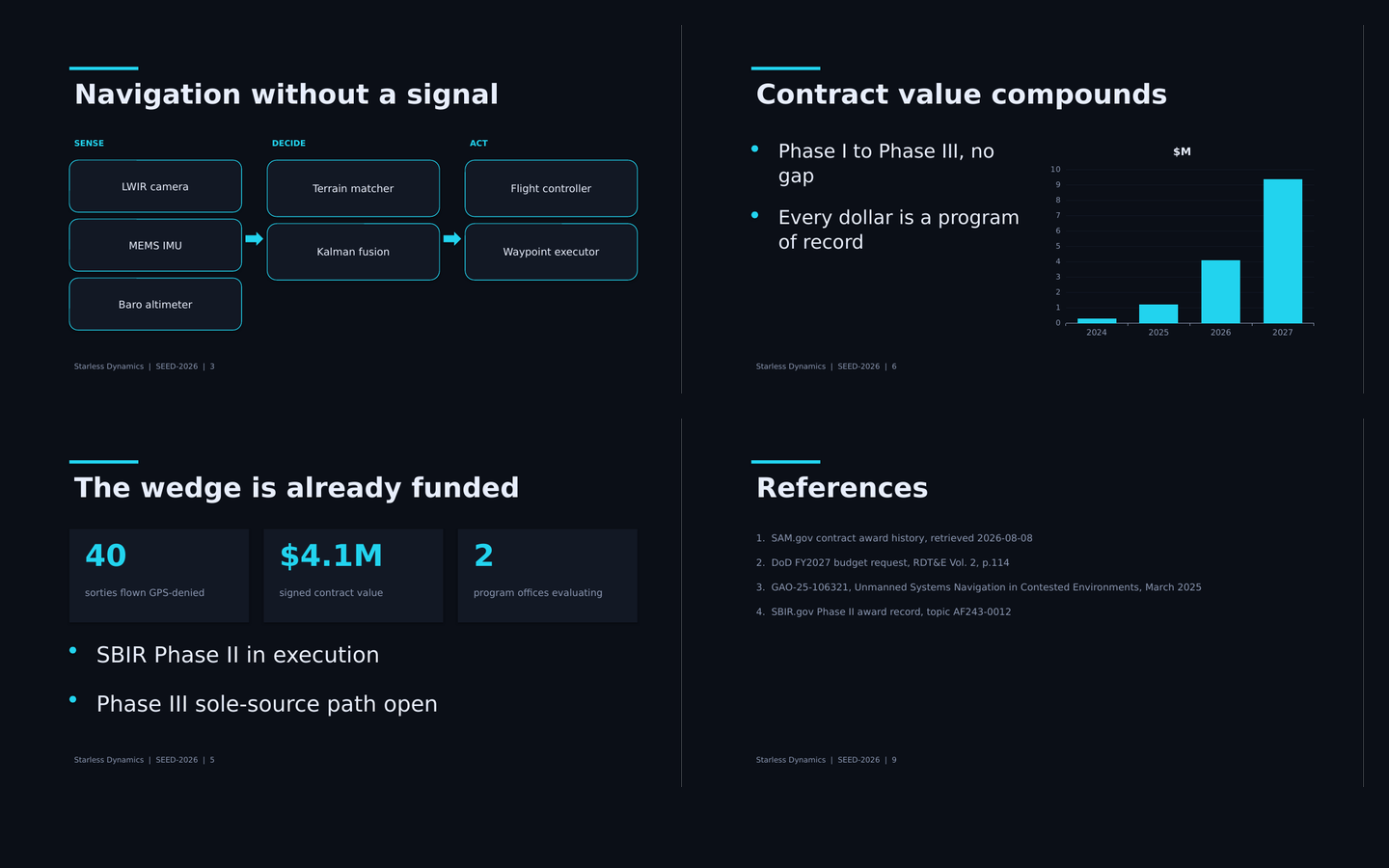
Generated pitch deck slides: systems architecture, native chart, metrics and references

Pitch decks in the format investors expect

  • Choose Y Combinator's seed order or Sequoia's business-plan order before generating — the structure is shown slide by slide with each source's own guidance, because the running order is the argument
  • Slides carry native PowerPoint charts, headline metrics, spec sheets and a drawn systems architecture — not a wall of bullets
  • Every deck ends with a references page carrying the source and date behind each figure, and a contact page
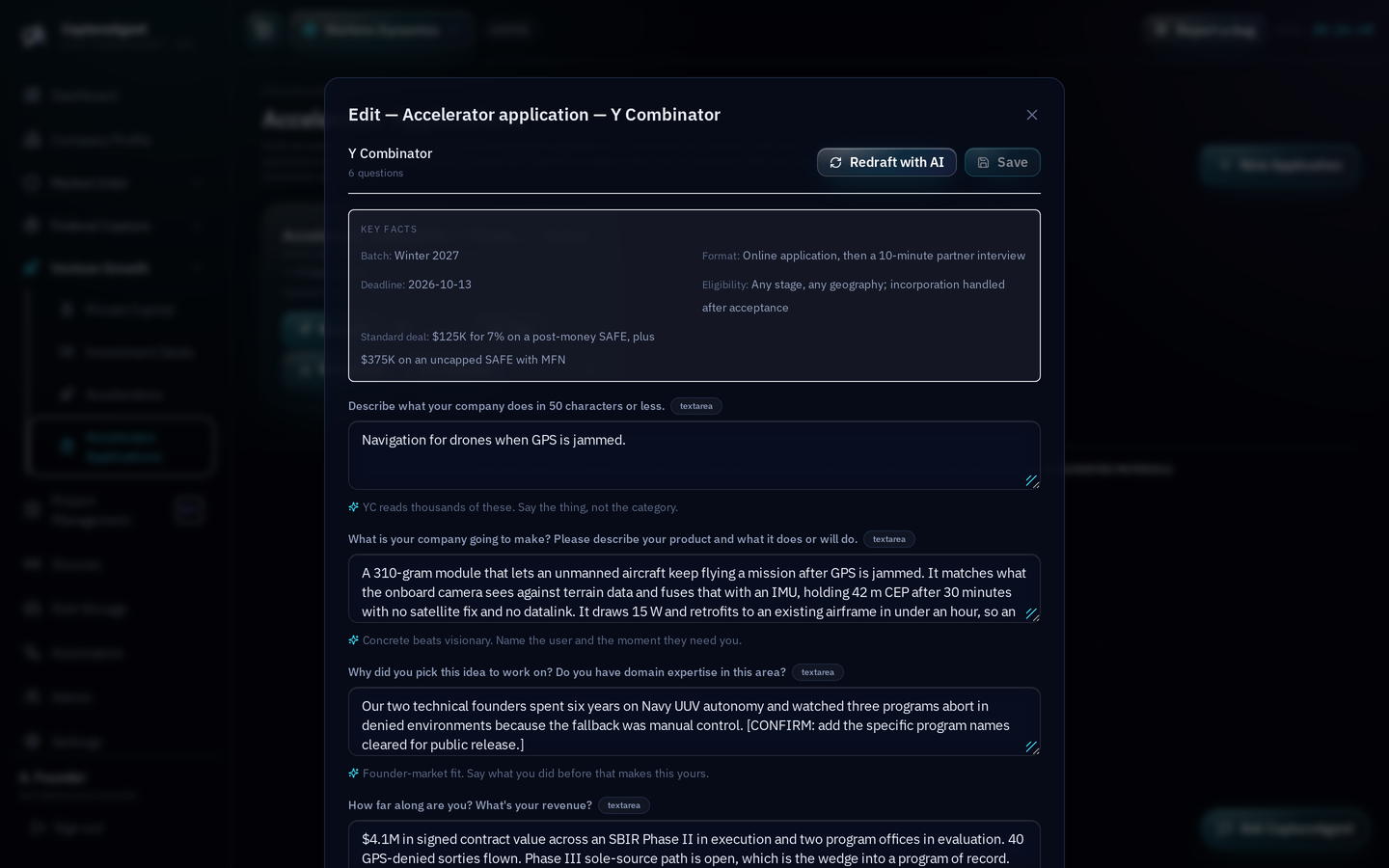
A Y Combinator application open as a fillable form — the program's own questions with drafted answers

Accelerators and applications

  • The application is built from the program's own page: Y Combinator's actual questions, in its own words, as fields you fill in — not a generic template
  • Key facts pulled alongside them — batch, deadline, the standard deal — so you are not reading the terms in another tab
  • Every answer drafted from your company profile and past performance, each with a tip on what a strong answer does, and [CONFIRM] wherever a figure has to come from you
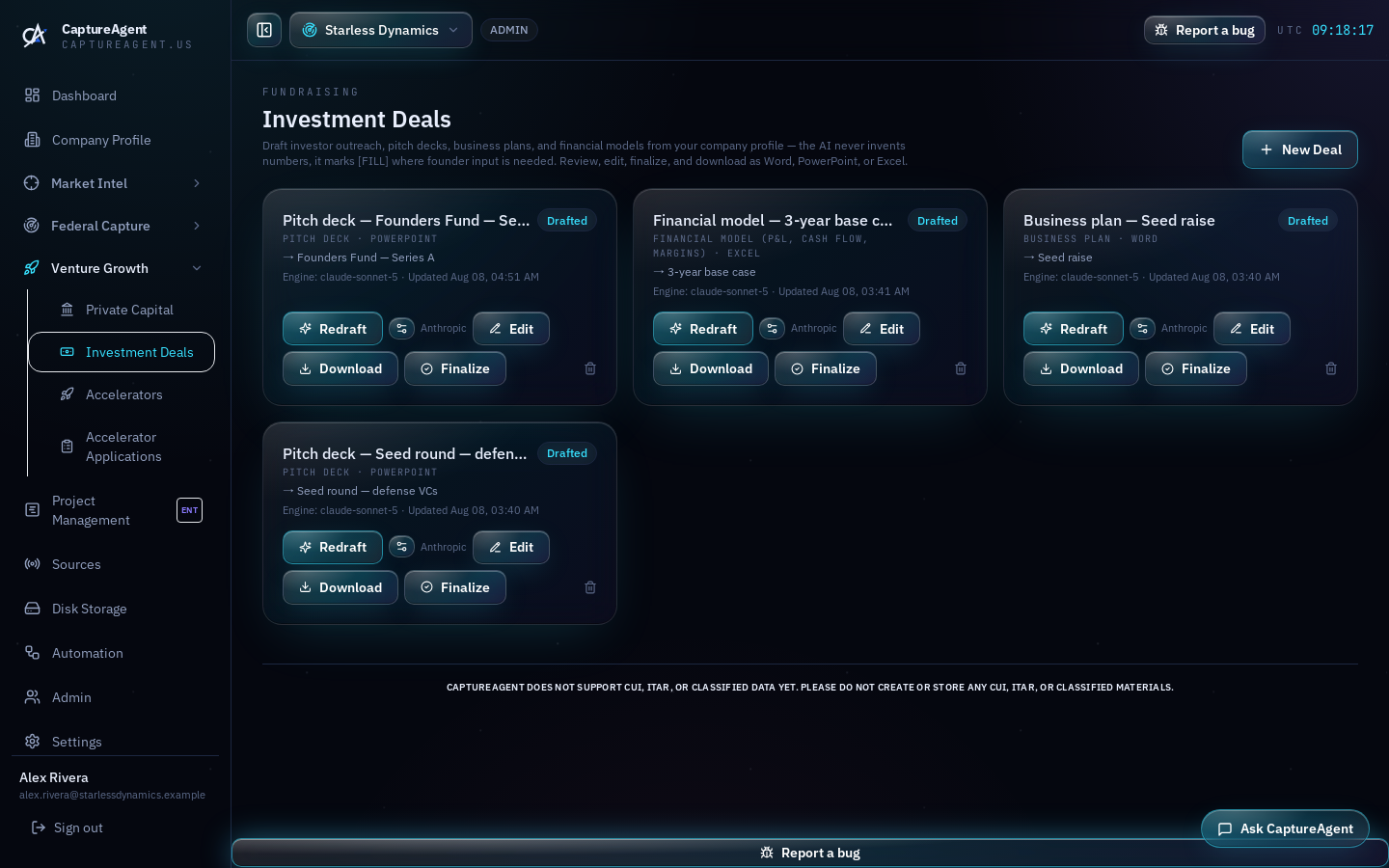
Investment deal workspace with the generated financial model

Investment deals and financial models

  • A full financial model — P&L, cash flow, margins, cap table and the government contract pipeline — exported to Excel
  • Native charts sit beside every table, so the workbook opens as something an investor can read rather than a grid of numbers
  • Business plans and outreach drafted from the same profile, so the deck, the plan and the model tell one story
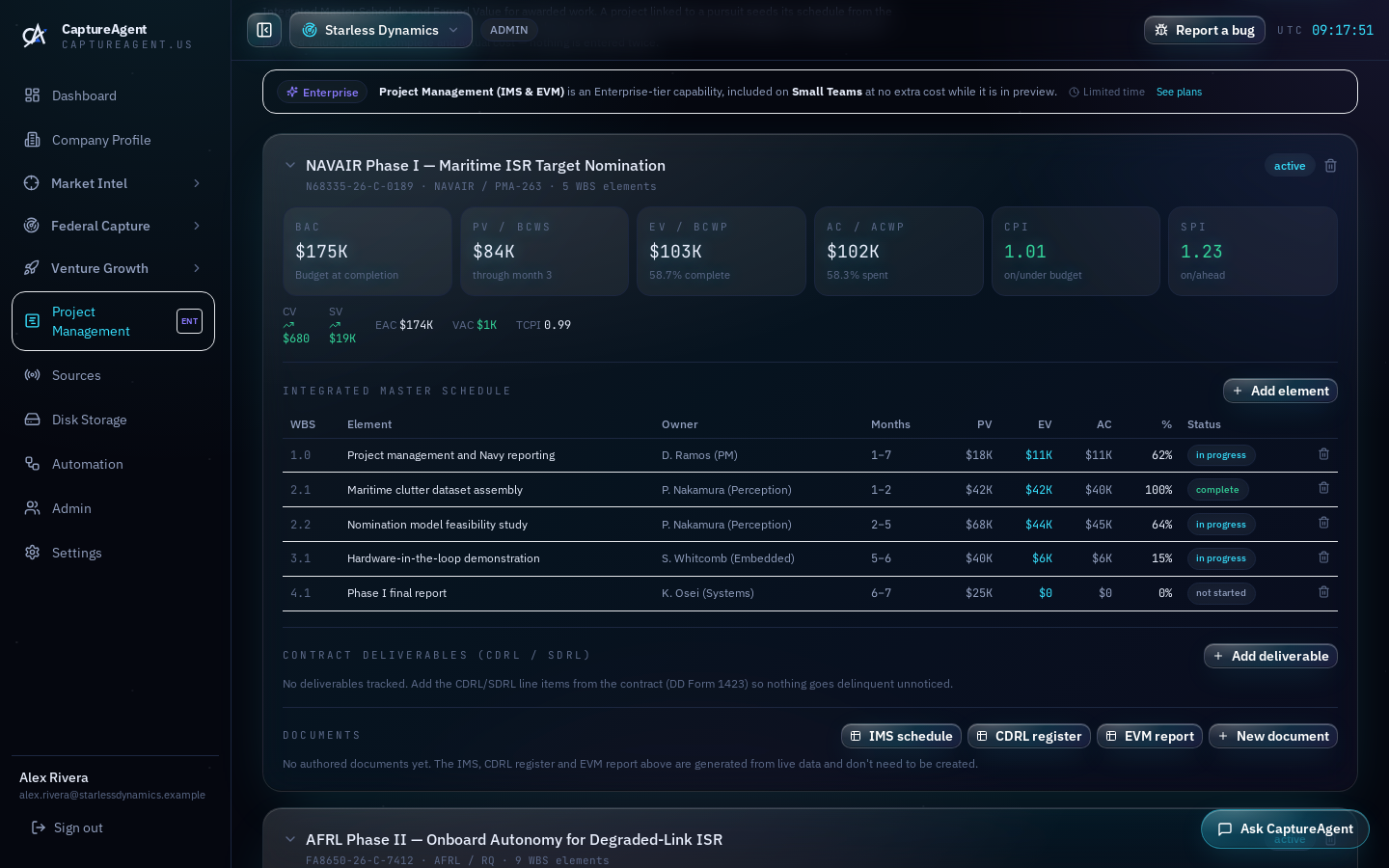
Active projects with named owners, earned value and schedule

Post-award execution

  • Every award becomes a project with a real integrated master schedule — WBS, named owners, planned versus actual cost, percent complete and predecessors
  • Earned value falls out of the schedule instead of a spreadsheet somebody maintains by hand
  • Seed the schedule from the WBS you proposed, so execution starts from the plan the government bought — CDRLs beside the work that produces them
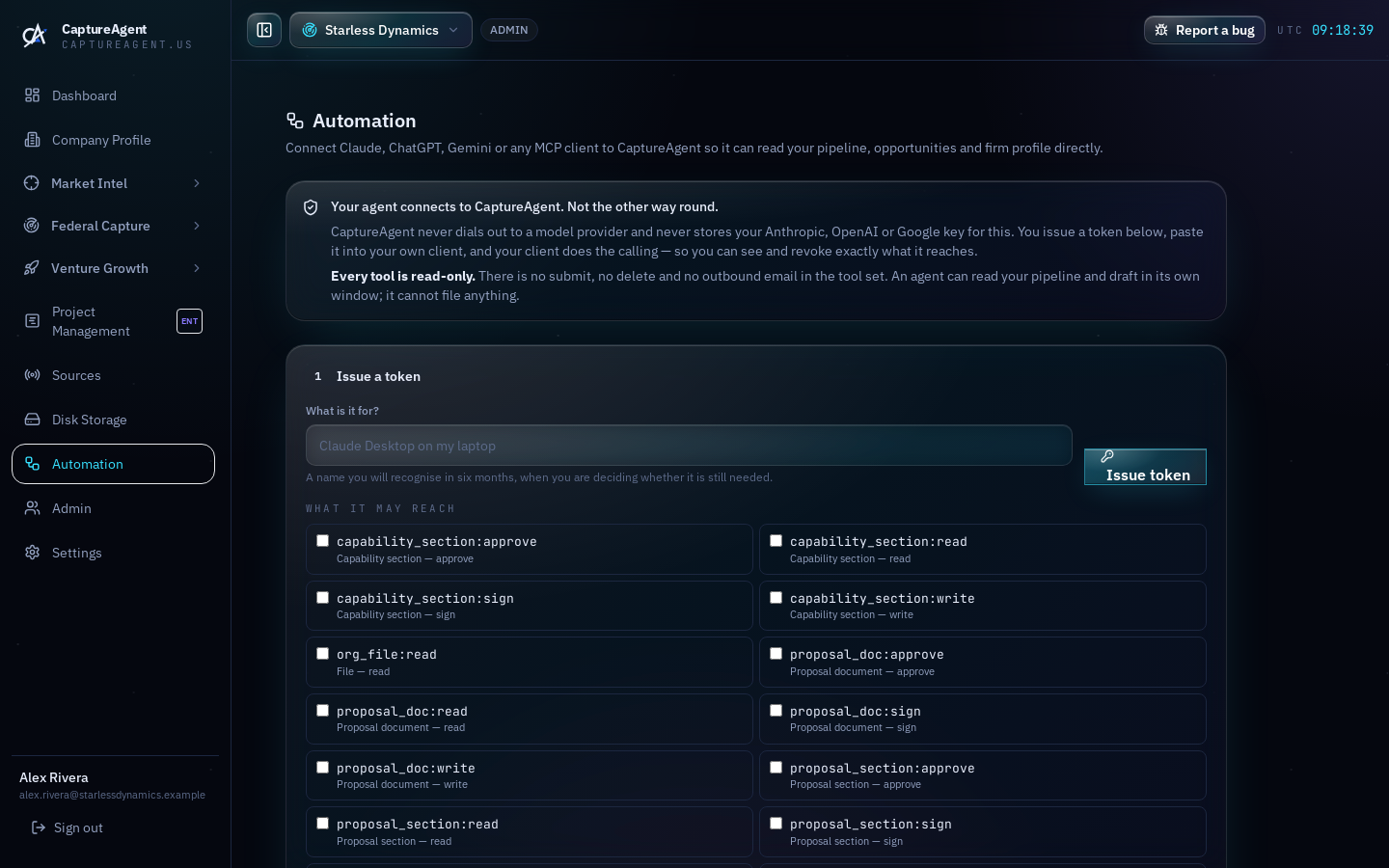
Agent tokens with fine-grained scopes and last-used timestamps

Automation, MCP and governance

  • Connect Claude, ChatGPT, Gemini or any MCP client — CaptureAgent speaks JSON-RPC 2.0 as an MCP server, with copy-paste config for Claude Desktop
  • Agent credentials carry the same permission vocabulary as your people. Read tools by default; write tools return a proposal a human approves, so an agent is never one call away from filing with the government
  • Eight roles that mirror a real capture shop, subcontractors scoped to named proposal sections only, and every action audit-logged
The in-context assistant answering a question about the open opportunity

Ask CaptureAgent, on any page

  • The assistant reads the page you are on, so 'is this one worth bidding?' is answered about this opportunity rather than in general
  • It cites the record it used — the fit score, the compliance gap, the award history — instead of asserting
  • Runs on your key and your engine, and never writes to your pipeline without you asking

Security architecture

Bring your own API keys for SAM.gov, Claude, ChatGPT, Emergent and AskSage — envelope-encrypted per organization and invisible even to the operator

Masked previews only; full keys never reach any browser; per-org rotation on demand, with a purpose-tagged audit trail for every use

Postgres with row-level security on every table, login lockout, and httpOnly cookies

See it with your own pipeline

Free to set up. Your keys, your data, your wins.

Create your workspace